Browse by category
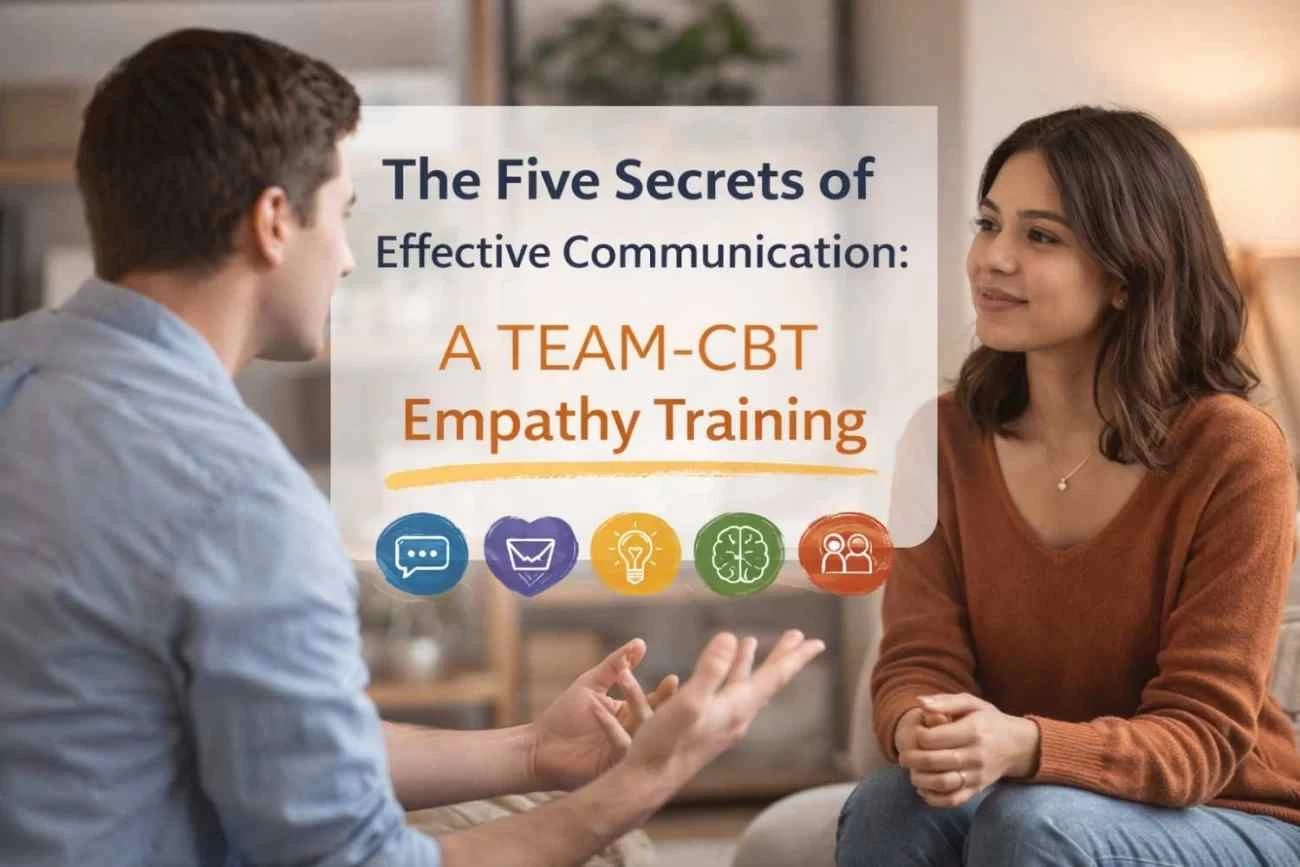
The Five Secrets of Effective Communication: A TEAM-CBT Empathy Training
A Webinar Summary by Dr. Jill Levitt
Hey everyone,
What a day we had! Over 1,000 people joined us live, with 60% therapists and 40% general public—which tells you something important: empathy isn't just a therapy skill, it's a human skill. And most of us? We're pretty terrible at it.
Today David and I taught you the Five Secrets of Effective Communication—the empathy skills that form the E in TEAM-CBT. But here's the kicker: we also showed you research proving that therapists are only 9% accurate at knowing how empathic their patients think they are. Let that sink in. We think we're connecting, but we're mostly just guessing.
So let's dive into what you learned today, and more importantly, how you can actually get good at this.
The Origin Story: Sterling Morey and the Birth of the Five Secrets
David shared this beautiful story about how he discovered these techniques. Back in the 1970s at Penn, Dr. Aaron Beck sent a British medical student named Sterling Moorey to observe David's sessions. Sterling had never studied psychology or psychiatry—he knew nothing.
But something magical happened.
David was assigned a patient, Jerome, with severe paranoid schizophrenia who was shouting about John the Baptist giving him spiritual secrets. David felt the best action was to up his meds and felt completely lost beyond that.
Then David asked Sterling: "What would his approach be?"
Sterling simply said: "Well, Jerome, we in England have a great interest in religious things. I've even taken two courses on religion in college, and I'm fascinated by what you're saying. If John the Baptist was telling you spiritual secrets about the future of the human race, I'd like to know what they are. What was he telling you?"
Everything changed.
Jerome opened up. They had an animated discussion. Halfway through, Jerome said, "Dr. Moorey, you helped me so much with that problem. I'm feeling a lot better now."
David realized: Sterling has something I don't have. So he spent the next weeks observing Sterling, giving names to his techniques, and developing training methods. That's how the Five Secrets were born.
What Is Empathy? (And Why You're Probably Not As Good As You Think)
Accurate empathy has three components:
- Thought Empathy: Understanding exactly how the other person is thinking
- Feeling Empathy: Understanding exactly what feelings they're experiencing
- Warmth/Acceptance: Conveying genuine care, compassion, and trust
The Shocking Research
David conducted a study with 178 consecutively admitted inpatients at Stanford. After 2-3 hour diagnostic interviews, he had experts rate how depressed, suicidal, anxious, and angry the patients were—and how empathic they'd been.
Then he had patients fill out the same ratings separately.
The results:
- Depression detection: 3% accurate
- Suicidal ideation: 0% accurate
- Anxiety: 5% accurate
- Anger: 0% accurate
- Empathy: 9% accurate
A taxi driver could have guessed just as well.
Independent research by Hatcher (1995) found the exact same thing: 9% accuracy on shared empathy experience.
E-A-R: The Framework for Connection
The Five Secrets fall into three categories that spell E-A-R:
- E = Empathy (Disarming, Thought Empathy, Feeling Empathy, Inquiry)
- A = Assertiveness (I Feel Statements)
- R = Respect (Stroking)
Let's break down each secret:
Secret #1: The Disarming Technique
Definition: Finding and acknowledging the true part in a criticism—without defending, explaining, or pushing back.even if it seems illogical, unfair, or just plain wrong.
When you name that truth respectfully, the emotional charge drops—and connection becomes possible.
This is based on David's Law of Opposites:
Example from the webinar:
A hospitalized suicidal teenager shouts at his psychiatrist: "You're stupid!"
Bad response: "I'm not stupid. I went to Harvard Medical School and have a PhD from MIT."
Good response: "You know, I'm feeling pretty stupid right now, because I haven't been helpful to you at all, and you have every right to be angry with me. The nurses told me you're trying to get out of the hospital to complete your suicide attempt. If I let you out and you died, I don't think I could live with myself. But I agree that I've really failed you because I haven't been at all helpful. I'd like to hear more about what it's been like for you and how angry and frustrated you feel."
The teenager melted, cried, opened up, and formed a real connection.
Secret #2: Thought Empathy
Definition: Paraphrasing the other person's words so they know you're listening.
Take notes during sessions. Repeat back what they said: "So what I'm hearing you say is A, B, and C. Am I getting that right?"
Secret #3: Feeling Empathy
Definition: Acknowledging how the other person is feeling, using feeling words.
"I can imagine you might be feeling hurt, disappointed, and probably pretty angry with me too, and for good reason."
Critical point: In our live practice, Chris failed to acknowledge Katie's anger—the #1 error therapists make. When someone's angry and you don't name it, they get even more pissed off.
Secret #4: Inquiry
Definition: Asking gentle probing questions to encourage them to open up.
"Can you tell me more? Am I getting you right? This sounds really important—what else are you feeling?"
End with inquiry inviting the hardest feelings: "Were you also maybe feeling a little bit hurt or resentful?"
Secret #5: I Feel Statements
Definition: Sharing your own feelings using actual feeling words (not criticisms).
Formula: "I feel [feeling word]"
Good: "I feel sad and ashamed right now because I've been letting you down."
Bad: "I feel like you're being defensive." (That's a criticism, not a feeling!)
Stroking: Finding something genuinely positive to say, even in the heat of battle.
"I really appreciate how open and vulnerable you've been with me."
Positive Reframing: Framing the conflict as an opportunity.
"This is painful for both of us right now, but I think talking this through could bring us closer and help us do the kind of work you're hoping for."
The Live Practice: Learning Through Joyous Failure
We invited Katie and Chris from the audience. Katie played an angry patient; Chris responded as the therapist.
Katie's attack (A+ performance):
"Chris, you're a horrible therapist. You do a horrible job of listening. You don't even know how I'm feeling. I'm feeling so anxious and terrified, and you're just trying to push me to fix it. I can't believe you've helped any other clients. You're totally unhelpful!"
Chris's response:
"Katie, that was difficult to hear, but I'm so glad you told me. You're right—I have not been a good therapist for you. I haven't made you feel heard, and I haven't given you the support you needed. I want to sincerely apologize. I would appreciate it if you could spend a few more minutes with me to tell me more about how you're feeling so I can learn to be a better therapist."
Grades:
- Chris gave himself a D
- Katie gave him a B
- We gave him a B+
What worked: Beautiful disarming. Acknowledged he hadn't helped her. Genuine humility.
What didn't work:
- Missed her anger completely (the #1 error)
- Inquiry was self-centered: "Tell me more so I can be better" vs. "Tell me more about your pain"
- Missed some thought empathy: She said he was pushing her to do things—he didn't repeat that back
David's masterful response:
"You know, Katie, it's really painful to hear what you're saying, because I have to say I'm with you 100% on all three things. I feel sad and ashamed right now because I do have tremendous respect for you. Your scores have been getting worse every week, and in the last few sessions, instead of working together as a team, this adversarial thing has come in. Yes, I have had feelings of dislike and frustration and anger for you in the last couple sessions, and I wouldn't be surprised if you're feeling that too. As painful as this moment feels, I think this is exactly what we need to talk about to get on the same page. Tell me more—I can imagine you're feeling hurt, angry, discouraged, and for good reason."
Chris said afterward through tears: "This mirrors what I'm going through in my actual life right now... Seeing you do it correctly—I learned so much more than just reading slides."
Common Errors to Avoid
Disarming Errors:
- Patronizing: "I can see how you might feel that way" (implies they're wrong)
- Defensiveness: "You're right, I kept you waiting because A, B, C happened..." (explaining = defending)
- Failure to see truth: Not finding the genuine grain of truth in the criticism
I Feel Statement Errors:
- Not sharing feelings: Staying detached/professional
- Fake feelings: "I feel like you're being defensive" (that's a criticism!)
- Overwhelming the other person: Dumping your problems on them
Feeling Empathy Error:
- Not acknowledging anger: The single biggest mistake therapists make
How to Assess Your Empathy
Method 1: The Empathy Scale
Have every patient fill out the empathy scale at the end of every session. A perfect score is 20. If you get 19 (like one item is "Very True" instead of "Completely True"), that's a failing grade. The patient is telling you something's missing.
Method 2: Ask for Letter Grades
After empathizing, ask: "How am I doing? Can you give me letter grades on: (1) Understanding your thoughts, (2) Understanding your feelings, (3) Warmth and acceptance?"
If they give you a B, ask: "Tell me more about what I'm missing."
Explore the full process step by step in the webinar: Five Communication Secrets
Jill's Transformation Story
Eighteen years ago, I moved to California and joined David's Tuesday group thinking I had excellent empathy skills. I discovered I had a LOT to learn. And it transformed my therapy practice and my personal life. Suddenly I could actually listen to my mom's complaints instead of rushing to problem-solve. I could handle anything my patients threw at me. And I had tools I could teach my patients for their own relationships.
It was challenging. It took hard work. But it was life-changing.
Your Practice Assignment
This week, do ONE of these:
- With a colleague: Practice the challenging exercise. One person says: "You're not helping me. You don't get me. You don't even like me." The other responds using all Five Secrets. Switch roles. Keep practicing until you both get an A.
- In your next session: Use the empathy scale or ask for letter grades. Be brave enough to hear the truth.
- Journal: Write about a recent conflict. What would a Five Secrets response have sounded like?
Take the first step toward feeling like yourself again — get started with online CBT therapy.
Appendix: TEAM‑CBT Roadmap
TEAM is an acronym for Testing, Empathy, Assessment of Resistance, and Methods—but more than just a checklist, it’s a structured roadmap that integrates the strongest predictors of successful outcomes into every session. It’s flexible and effective across anxiety, depression, OCD, trauma, habits, addictions—and more.
Core Components
- T — Testing: Use brief, validated measures (e.g., a daily mood log) at the beginning and end of every session to track progress, spotlight alliance ruptures, and pinpoint exactly where to focus your next move.
- E — Empathy: Before introducing any techniques, deeply understand the client’s experience by using the Five Secrets of Effective Communication—listening for emotions, reflecting accurately, validating feelings, asking gentle questions, and summarizing succinctly. These refined skills build trust, repair ruptures, and create a safe container so your client feels truly heard.
- A — Assessment of Resistance: This phase uncovers outcome resistance (good reasons NOT to change) and process resistance (good reasons NOT to do the work required for change). By surfacing the hidden “benefits” of a problem—using paradoxical invitations, cost–benefit analyses, and “magic button” questions—you transform resistance into genuine client‑driven motivation and collaboration.
- M — Methods: This phase taps into over 100 powerful cognitive, behavioral, and interpersonal interventions.. From cognitive restructuring and role‑plays to behavioral experiments and exposure therapy, each technique is tailored to your client’s unique needs, translating insight into targeted action for rapid symptom relief & lasting change.
Each method builds on the previous ones, creating a powerful sequence that honors resistance before attempting change—the heart of what makes TEAM-CBT so effective!
Curious how this works in real life? Explore how this approach can help you